




Accenture’s latest Pulse of Change research reveals supply chain disruption remains the defining operational challenge, driving organisations to prioritise diversification, forecasting, and AI-enabled resilience over reshoring.
DISRUPTION RESHAPES STRATEGY
Supply chain disruption is continuing to redefine how organisations approach long-term operational strategy, according to new research from Accenture.
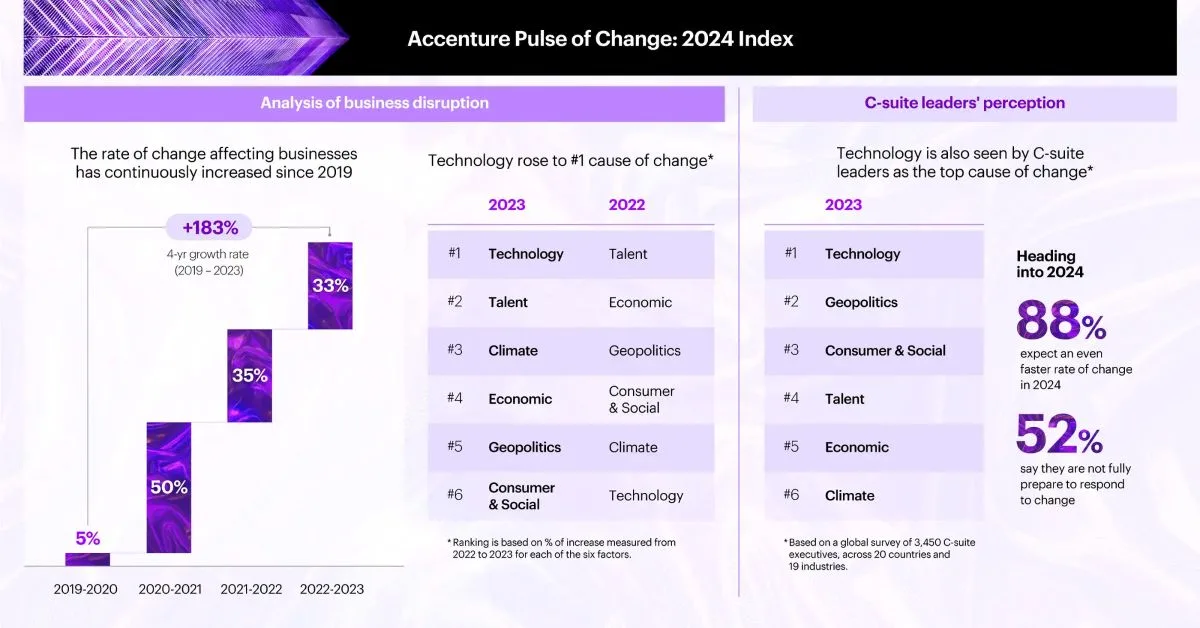
Drawing on insights from 3,000 C-suite leaders across 20 countries and 19 industries – including 322 senior supply chain and engineering (SC&E) executives – the latest Pulse of Change survey reveals that persistent uncertainty is making operations increasingly difficult and influencing where businesses are directing investment.
More than three-quarters (78 percent) of SC&E leaders say geopolitical uncertainty, economic volatility, regulatory complexity, and compliance pressures have made operations materially harder over the past six months.
While concern levels are broadly aligned across the wider C-suite, operational leaders remain more focused on maintaining supply chain continuity and controlling rising operating costs than accelerating technology adoption.
For many organisations, the findings suggest resilience has become a competitive necessity rather than a reactive measure.
BUILDING RESILIENCE OVER RESHORING
Six in 10 SC&E executives identify supply chain disruption as the issue most likely to force a significant strategic shift in 2026, ahead of emerging technologies, trade and compliance changes, and labour shortages.
That outlook is directly shaping investment priorities.
Rather than pursuing large-scale production moves, 59 percent of SC&E leaders are prioritising forecasting, scenario planning, and risk management. Almost half are also diversifying supplier networks, while others are reassessing capital expenditure, expanding mergers and acquisitions or partnership activity, and strengthening geopolitical risk management capabilities.
Despite ongoing geopolitical uncertainty, reshoring remains a comparatively low priority.
Fewer than one-third (29 percent) of operational leaders intend to reshore or nearshore operations, making domestic production the lowest-ranked strategic priority once again, although its importance has increased since January.
Instead, businesses are adapting existing commercial relationships to reflect changing geopolitical realities. Two-thirds (67 percent) of SC&E executives report they have already altered the terms, scope, or governance of partnerships based on a partner’s country of origin or geopolitical alignment.
AI AND PEOPLE GO HAND IN HAND
Artificial intelligence continues to attract significant investment, although SC&E leaders are approaching implementation differently from the broader executive leadership.
More than two-thirds (68 percent) expect to increase AI investment over the next year, compared to 82 percent across the wider C-suite. Rather than focusing primarily on immediate financial returns, operational leaders are placing greater emphasis on workforce readiness.
Seven in 10 organisations are investing in employee upskilling and reskilling programmes, preparing staff to work alongside AI through new team structures and greater cross-functional collaboration. Many also expect human and AI integration to expand rapidly, either across multiple business functions or throughout entire organisations within the next 12 months.
Regional priorities also vary considerably. Talent shortages are viewed as the most significant disruption in the Americas, where more than half (56 percent) of SC&E leaders expect labour challenges to drive strategic change. Meanwhile, APAC organisations are placing greater emphasis on supplier diversification, while EMEA leaders are more focused on strengthening geopolitical risk management.
Commenting on the findings, Tracey Countryman, Global Supply Chain and Engineering Lead at Accenture, said:
“Supply chain and engineering leaders are already managing through an environment of constant disruption. Rather than making big bets on moving production closer to home, they’re building resilience through better forecasting, diversified supplier networks, and stronger risk management to deliver measurable business outcomes.”

“They’re investing in AI through a practical, workforce-led lens, helping their people make faster, AI-enabled decisions and adapt more effectively as conditions continue to change,” she added.
The research suggests that, as disruption becomes an enduring feature of the global operating environment, organisations are increasingly favouring agility, diversified supplier ecosystems, and workforce-enabled AI adoption over fundamental changes to manufacturing location.
This article was produced by the editorial team at Supply Chain Outlook and published as part of the Outlook Publishing global network of B2B industry magazines.
Outlook Publishing delivers industry insights, company stories, and sector coverage across supply chains, manufacturing, mining, construction, healthcare, food production, and sustainability.
Supply Chain Outlook provides ongoing coverage of organisations and developments shaping the global logistics and supply chain sector.