



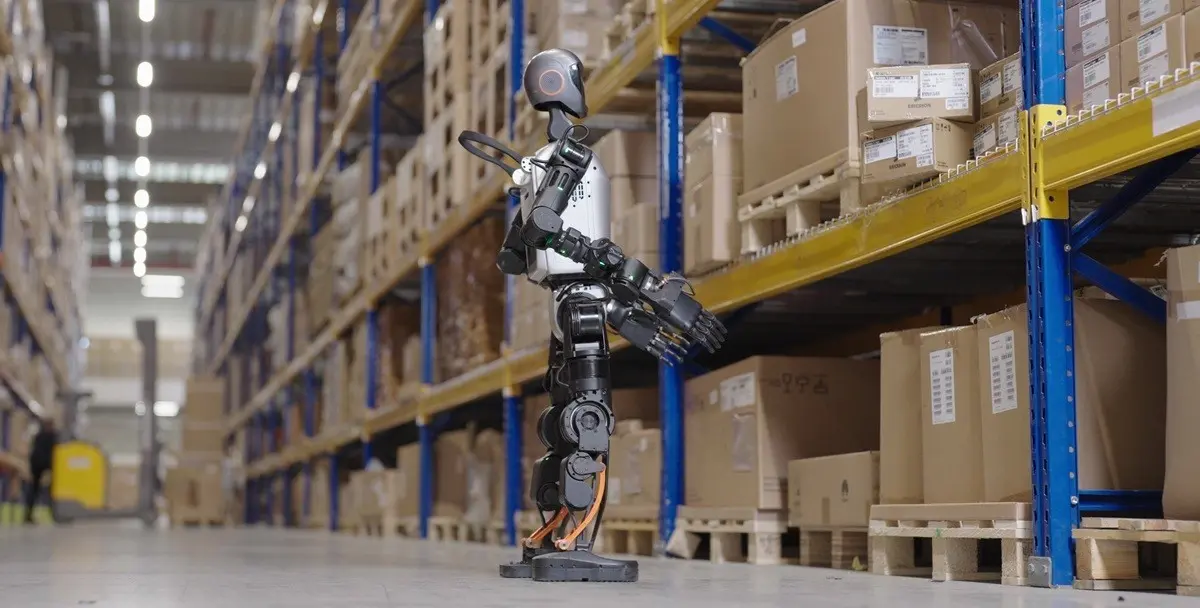
Warehouse automation is entering a new phase as humanoid robotics moves from concept to practical deployment inside live supply chain environments as part of a pilot by Accenture, SAP and Vodafone Procure & Connect.
Accenture, working with Vodafone Procure & Connect and SAP, is piloting the use of humanoid robots in warehouse operations to improve efficiency, strengthen safety, and explore new workforce models for industrial supply chains.
The pilot, presented at Hannover Messe 2026, demonstrates how physical AI and advanced robotics can support real-world warehouse operations while creating new opportunities for automation at scale.
The warehouse pilot focused on how humanoid robots could operate alongside existing warehouse systems and support day-to-day operational decision-making. Key outcomes included:
- Detecting misplaced or damaged products
- Assessing pallet stacking and weight distribution
- Identifying unused storage space
- Highlighting safety hazards such as aisle obstacles and misaligned pallets
- Reporting findings directly into SAP systems for real-time visibility and action
The pilot was conducted at Vodafone Procure & Connect’s warehouse in Duisburg, Germany, where the humanoid robot received inspection tasks through SAP Extended Warehouse Management and autonomously carried out visual inspections across the facility.
Moving Beyond Robotics Experimentation
The initiative reflects a broader shift in industrial automation—from isolated robotics testing to scalable deployment inside operational environments.
The robot was designed to work alongside existing warehouse systems rather than replace them, helping operators improve inventory validation, warehouse safety, and workflow efficiency.
Christian Souche, Advanced Robotics lead at Accenture, said the business value extends beyond automation alone.
“Trained in digital twins and powered by physical AI, humanoid robots can reduce worker injuries and other warehouse safety incidents and lower overtime costs and the dependency on temporary labor.”
He added that the pilot also creates a foundation for future commercial opportunities.
“Equally important, Vodafone Procure & Connect will gather valuable data and insights on robot deployment and performance as a basis for a future humanoid workforce solutions business.”

Integrating Robotics into Core Supply Chain Systems
A major part of the pilot focused on making robotics work within existing enterprise systems rather than as a standalone technology.
SAP led the integration of the robots into the warehouse management platform, enabling robots to receive tasks, process warehouse conditions, and report findings directly into operational workflows.
Dr. Lukasz Ostrowski, head of Embodied AI & Robotics at SAP, explained how this creates stronger compliance and decision-making.
“At Vodafone Procure & Connect, we’re leveraging Joule, SAP’s AI execution fabric and interface for embodied AI, connecting robots to end-to-end processes and business logic and enabling them to know why, when and how to act.”
“By grounding actions in trusted SAP data, we can automate health and safety incident reporting and real time inventory validation to protect workers and strengthen compliance through consistent auditable workflows.”
This kind of closed-loop integration is becoming increasingly important as companies look to automate not just physical movement, but decision-making itself.

Building the Future Warehouse Workforce
For Vodafone Procure & Connect, the pilot is also about understanding how humanoid robotics could shape future workforce models across its broader supply chain network.
Reinhard Stefan Plaza Bartsch, global Network Logistics director at Vodafone Procure & Connect, said the project provides valuable operational insight.
“Through this pilot, we are exploring how humanoid robotics can improve efficiency, safety and operational visibility in our warehouse operations.”
“It also gives us a clearer view of how these capabilities could scale across our supply chain and support future business models.”
Rather than focusing purely on labour substitution, the project examines how robotics can improve resilience, reduce safety incidents, and create new service offerings.
Powered by Physical AI and Digital Twins
The humanoid robots used in the pilot run on Accenture’s Robot Brain solution, allowing them to interact with human operators through voice, gestures, and text.
They are trained using digital twins of warehouse environments built on Accenture’s Physical AI Orchestrator, supported by NVIDIA Omniverse libraries and NVIDIA Metropolis tools for visual AI deployment.
This allows the robots to move beyond repetitive single-task automation and learn new skills through imitation and reinforcement learning.
Prasad Satyavolu, global lead for Manufacturing, Operations and Physical AI at Accenture, said this full-cycle approach is critical.
“Our work in collaboration SAP is a great example of how holistic deployment of humanoid robots – from simulation and training to warehouse deployment and integration with SAP data – creates a closed loop with transactional systems.”
This article was produced by the editorial team at Supply Chain Outlook and published as part of the Outlook Publishing global network of B2B industry magazines.
Outlook Publishing delivers industry insights, company stories, and sector coverage across supply chains, manufacturing, mining, construction, healthcare, food production, and sustainability.
Supply Chain Outlook provides ongoing coverage of organisations and developments shaping the global logistics and supply chain sector.