




Amir Khoshniyati, Vice President of Wiliot, explores how physical artificial intelligence is closing the gap between digital systems and physical reality, enabling supply chains to move beyond static visibility and build continuously aware networks powered by real-time operational truth.
In 1974, a cashier in Troy, Ohio scanned a pack of Wrigley’s gum and changed commerce.
The barcode gave products a machine-readable identity meaning retailers could price faster, replenish more accurately, and support modern supply chains.
Radio frequency identification (RFID) advanced that foundation by giving supply chains a faster, more automated way to identify goods and assets at key points across the network.
It helped reduce dependence on manual scanning and created new levels of visibility. Yet, RFID, like the barcode, is still largely tied to specific read events and fixed points of interaction.
Half a century after the first barcode scan, supply chains face another inflection point. The barcode made products identifiable. RFID made that identification more automated. Physical artificial intelligence (AI) is now making products continuously knowable.
That distinction is critical because most supply chains still operate on a snapshot-based sense of reality: a scan confirms that a pallet left a warehouse, a receiving event confirms it arrived, and a system records that inventory exists. But between those events, reality moves faster than the systems meant to represent it.
Products can sit in the wrong zone, pallets can dwell too long at a dock, and fresh food can be exposed to temperature conditions that compromise quality.
Reusable assets can disappear into a partner’s network, whilst store inventory may appear available in software even when the shelf is empty.
The industry has invested heavily in digitisation, automation, analytics, and now AI. Yet, each investment depends on accurate, timely data about what is actually happening in physical operations.
That is where physical AI becomes critically important.
THE DATA GAP BETWEEN SYSTEMS AND REALITY
AI is only as useful as the signals it receives and in many supply chains, those signals still come from manual scans, periodic audits, transactional records, and delayed reconciliations.
These inputs are valuable, but they create a partial picture, often telling systems what was recorded minutes, hours, or days after reality changed.
Physical AI addresses this gap by applying AI to data generated by physical objects and environments.
It combines persistent object identity, low-cost sensing, wireless connectivity, machine learning, and contextual reasoning.
The result is a live operational data layer that understands location, motion, temperature, humidity, dwell time, proximity, and chain-of-custody.
Whilst AI can forecast demand, optimise routes, and analyse historical patterns, physical AI gives those systems a real-time connection to the physical conditions shaping outcomes right now.
For retailers, it means knowing whether an item is truly on the shelf, in the back room, in transit, or exposed to conditions that make it unsellable.
For grocers, it means identifying specific shipments affected by a temperature excursion.
For logistics operators, it means seeing where assets are idle, missing, or moving inefficiently.
The operational value comes from replacing assumption with real-time observation.

WHY THE MOMENT HAS ARRIVED
The idea of connected objects has existed for decades, but economics and infrastructure limited its reach.
Traditional RFID created value at fixed read points and battery-powered trackers enabled richer visibility, especially for high-value assets – but cost, maintenance, and battery replacement constrained item-level scale.
Several conditions have now converged: wireless infrastructure is more pervasive, cloud systems can ingest and process streaming data, AI models can interpret large volumes of physical signals, and energy-harvesting and battery-free sensing architectures make it viable to attach intelligence to lower-cost goods, packaging, pallets, totes, and returnable assets.
At the same time, volatility has increased the cost of weak visibility. In retail, inaccurate inventory undermines omnichannel fulfilment, in logistics, lost assets and mis-shipments consume labour and capital, and in healthcare and pharmaceuticals, poor condition visibility can become a compliance and safety issue.
Companies increasingly need supply chains that can sense continuously, interpret conditions quickly, and guide action before small exceptions become larger failures.
“Companies increasingly need supply chains that can sense continuously, interpret conditions quickly, and guide action before small exceptions become larger failures”
Amir Khoshniyati, Vice President of Wiliot
WHAT PHYSICAL AI CHANGES IN DAILY OPERATIONS
Physical AI is best understood through the workflows it improves.
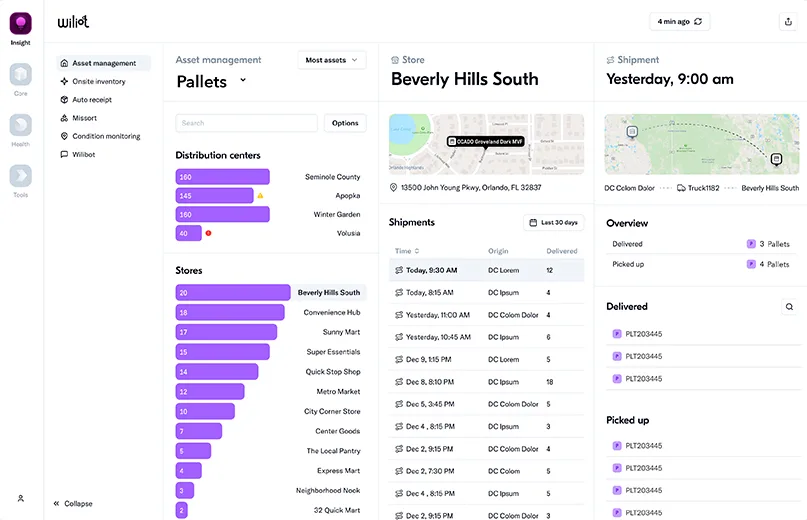
In inventory management, continuous sensing can support automated cycle counts across storage areas, backrooms, cross docks, vehicles, and stores.
Workers gain a more current view of what exists and where it is located, improving replenishment accuracy.
In receiving, tagged goods can be identified automatically as they arrive, accelerating dock-to-stock workflows.
In outbound operations, shipment verification can detect mis-loads before a truck leaves the facility, preventing costly downstream corrections.
In cold chain operations, temperature and environmental data can travel with the case or pallet, creating a precise exposure record and enables faster decisions about quality, routing, replenishment, and claims.
In reusable asset networks, continuous visibility can show where pallets, totes, racks, carts, or cages are sitting, how long they dwell, and whether they are circulating efficiently.
Treating them as intelligent participants in the network reduces replacement costs and improves utilisation.
Across these use cases, the physical world becomes a continuous data source that supply chain systems can interpret and act on in real time.
AI NEEDS GROUND TRUTH
As autonomous AI agents reach deeper into supply chain operations, it becomes easy to imagine systems that reorder goods, reroute shipments, or adjust inventory flows with limited human input.
But that future will depend on ground truth data. An AI agent operating on stale or incomplete inventory records will optimise a representation of the supply chain rather than the supply chain itself.
An AI system that receives continuous data about movement, condition, and context can make more reliable recommendations and eventually support higher levels of automation.
The near-term opportunity is for physical AI to surface exceptions, prioritise work, recommend actions, and strengthen decisions.
It can help associates focus on judgment and problem-solving whilst routine verification, monitoring, and alerting become more automated.
A NEW OPERATING MODEL FOR SUPPLY CHAINS
The next great supply chain advantage will come from synchronising digital systems with physical reality, and the companies that succeed will know the state of goods and assets as conditions unfold.
The barcode gave commerce a common language for product identity, whilst RFID extended that identity with faster, more automated visibility at key points across the supply chain.
Physical AI builds on that progression by adding continuous awareness of movement, condition, and context — giving supply chains a more accurate understanding of how goods and assets behave in the real world.
For decades, supply chain leaders have tried to make better decisions with better systems.
The next step is making those systems aware of the real world they are meant to manage.
Physical AI gives supply chains something they have always needed: a continuous source of operational truth.
This article was produced by the editorial team at Supply Chain Outlook and published as part of the Outlook Publishing global network of B2B industry magazines.
Outlook Publishing delivers industry insights, company stories, and sector coverage across supply chains, manufacturing, mining, construction, healthcare, food production, and sustainability.
Supply Chain Outlook provides ongoing coverage of organisations and developments shaping the global logistics and supply chain sector.