



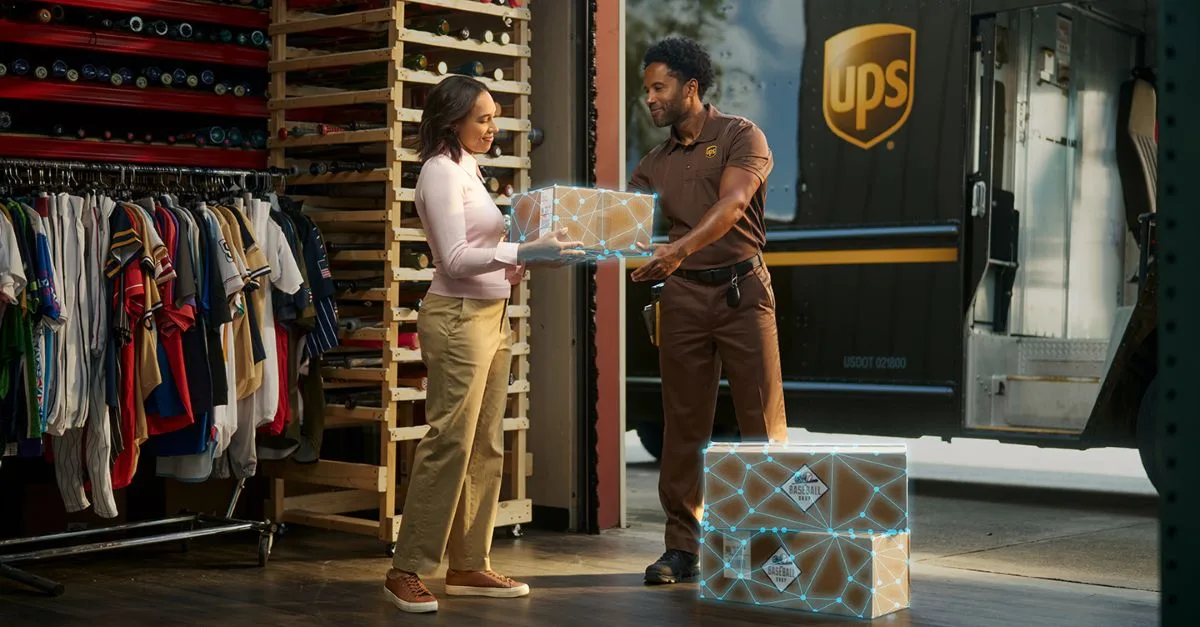
Underpinned by the companywide aim of simplification, UPS’s artificial intelligence-powered solutions combine the expertise of its half a million employees with cutting-edge technology to shape the future of the organization.
PROOF OVER PROMISES
For more than 118 years, UPS has continuously evolved its operations, and the company is now entering a new era powered by artificial intelligence (AI). By embedding AI across its business, UPS is enhancing customer experiences, strengthening supply chain resilience, and creating smarter, faster decision-making across its global logistics network.
“After 118 years of reinventing logistics, we have entered a defining moment – using AI to simplify how we work across the enterprise, from customer acquisition and onboarding to how we plan, move, and deliver,” said Carol B. Tomé, UPS CEO.

“We are pairing the deep expertise of our people with the power of AI to drive faster decisions and a better experience for our customers around the globe.”
Carol B. Tomé, UPS, CEO
ENHANCING CUSTOMER VISIBILITY
Every year, UPS customers generate billions of package tracking numbers, reflecting the scale of the company’s global operations. As supply chains become increasingly complex and market conditions continue to fluctuate, customers are looking for greater transparency than a simple estimated delivery date.
To meet these evolving expectations, UPS is expanding the use of AI to provide enhanced end-to-end visibility while improving customer support across multiple channels.
By the end of 2026, the company expects more than 98 percent of customer service requests to be supported through a combination of AI and human expertise across digital and voice channels, including AI-enabled intelligent assistants operating in more than 20 countries.
At the same time, customer care teams are being equipped with AI-powered, real-time shipment insights designed to resolve inquiries and claims more efficiently. UPS is also transforming reverse logistics through Happy Returns, introducing a conversational AI experience that simplifies the post-purchase journey while helping reduce returns fraud.
The company is further strengthening package visibility by combining radio-frequency identification (RFID) technology with AI-powered tracking capabilities, providing customers with near real-time package-level insights that support greater transparency, flexibility, and faster decision-making.
BUILDING A SMARTER GLOBAL NETWORK
Beyond customer-facing services, UPS is integrating AI throughout its logistics network to improve planning, responsiveness, and operational resilience.
Its proprietary network planning tools now model multiple “what if” scenarios using real-time information, including weather conditions, transportation delays, and volume forecasts. This enables the company to stress-test operations and prepare execution-ready plans before disruptions affect service.
UPS is also expanding its digital twin of the global network to encompass every mode of transportation. The digital replica includes facilities, air and ground operations, and end-to-end package flows, updating every 10 minutes to monitor performance continuously and allow the network to adapt in real time.
The company is also deploying agentic control tower capabilities directly with customers. By combining predictive models, connected services, and operational data, these capabilities extend beyond shipment tracking to identify, prioritize, and help resolve disruptions across complex multi-carrier networks while giving customers full control over their data.
SIMPLIFYING GLOBAL TRADE
International shipping is another area benefiting from AI-driven innovation.
UPS is introducing next-generation brokerage services that combine AI, cross-border data, and human expertise to help customers navigate customs requirements accurately for shipments of all sizes.
The company is also improving the cross-border experience through more predictable landed costs at checkout, enhanced product classifications using UPS Export Assure, and digital trade documentation via UPS Paperless® Invoice. Together, these capabilities help reduce errors and accelerate shipment processing.
AI is also strengthening UPS’s brokerage operations by enabling faster customs clearance. As a result, 97 percent of UPS shipments clear customs on the first day of entry.
“When trade rules changed, we needed to adjust fast without disrupting our customers,” said Michael Garcia, Vice President of Operations for Audien – the world’s largest over-the-counter hearing aid company.

“UPS helped us take a realistic, end-to-end look at how our products move so we could stay compliant and protect service. The result was a clearer path forward during a period of uncertainty – without slowing our business.”
Michael Garcia, Vice President of Operations, Audien
SHAPING THE FUTURE OF LOGISTICS
As part of its Network of the Future transformation, UPS continues to redesign its operations with a greater focus on data, resilience, and intelligent automation. By embedding AI across planning, routing, and execution, the company is creating a network capable of dynamically responding to changing operating conditions.
“Every step we’re taking supports our strategy – putting customers first, empowering our people, and accelerating innovation,” Tomé said.
“AI isn’t a buzzword at UPS. We are building on a rich history of technology embedded in every facet of our business. We are doing the work – using AI to transform global commerce.”
This article was produced by the editorial team at Supply Chain Outlook and published as part of the Outlook Publishing global network of B2B industry magazines.
Outlook Publishing delivers industry insights, company stories, and sector coverage across supply chains, manufacturing, mining, construction, healthcare, food production, and sustainability.
Supply Chain Outlook provides ongoing coverage of organisations and developments shaping the global logistics and supply chain sector.