



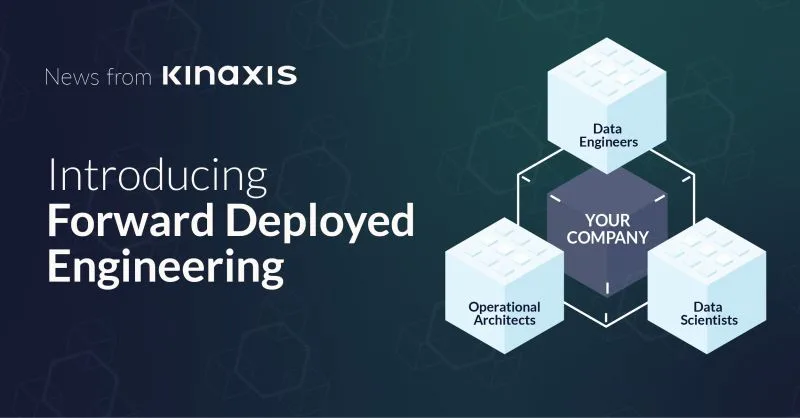
Kinaxis has introduced Forward Deployed Engineering (FDE), a new engineering-led engagement model designed to help enterprises operationalise AI and translate supply chain decisions into measurable business outcomes.
New Engagement Model Focuses on Turning Supply Chain Decisions Into Business Outcomes
Announced at the company’s Kinexions customer conference, the initiative is intended to help organisations move beyond traditional planning models by connecting decision-making more directly with operational execution.
FDE supports its broader vision of operational orchestration, an approach that coordinates signals, decisions, actions and learnings across enterprise operations to improve responsiveness and business performance.
Supply Chain Planning Evolves Toward Operational Orchestration
Kinaxis argues that traditional planning environments have often been constrained by siloed functions, fragmented workflows and disconnected decision-making processes.
While concurrent planning introduced more synchronised decision-making across supply chain functions, the company says operational orchestration extends these principles further by linking planning, execution and decision-making across broader enterprise operations.
The approach combines a unified data foundation with semantic intelligence capabilities designed to understand relationships, dependencies and trade-offs across business processes, this allows organisations to connect data, systems and teams more effectively while improving the execution of supply chain and operational decisions.
“The challenge companies face is no longer simply making better decisions faster, it’s ensuring those decisions drive real outcomes,” said Razat Gaurav, Chief Executive Officer, Kinaxis.
“A supply chain decision only matters when it changes what the business can do. The next shift is ensuring decisions translate into coordinated action across the business. That only happens when AI is grounded in the physics of enterprise operations, understanding the constraints, dependencies, and trade-offs that define how work gets done. With that context, organizations can move from isolated decisions to continuous execution at scale.”

AI Embedded Directly into Supply Chain Workflows
A central element of the strategy is the integration of agentic AI into operational workflows.
Kinaxis said its Maestro platform enables organisations to move beyond standalone AI assistants by embedding AI directly into supply chain and operational processes, this approach allows teams to work alongside AI systems that can continuously sense, reason, decide and act within the context of real-world business constraints.
Built on Kinaxis’ existing supply chain planning foundation, the platform is designed to support coordinated execution across complex operational environments while maintaining visibility into data, dependencies and resource constraints.
From Software Deployment to Outcome Delivery
The introduction of FDE also represents a shift in how Kinaxis engages with customers.
Rather than focusing solely on software implementation, the model is designed around collaborative solution development, enabling organisations to co-build AI-enabled operational capabilities using the Maestro platform.
The approach shifts engagement priorities:
- From features to outcomes, with a focus on measurable business impact.
- From projects to products, creating solutions that can scale and continuously improve.
- From go-live milestones to long-term ownership, supporting sustained adoption and value creation.
These engagements establish a foundation of operational data, workflows and decision logic that can support future AI expansion across the enterprise.
Building the Foundation for Enterprise AI
Kinaxis believes growing supply chain complexity, volatility and interdependencies are increasing demand for AI tools that can operate within the realities of enterprise operations and FDE helps organisations build an operational and intelligence foundation that can be extended over time through additional AI-driven capabilities.
By combining data, decisioning, orchestration and AI services within a composable platform architecture, Kinaxis aims to support more adaptive and responsive operating models.
The long-term objective is to create environments where human teams and AI agents work together across supply chain and enterprise processes, coordinating decisions and execution across the movement of materials, resources and operations.
This article was produced by the editorial team at Supply Chain Outlook and published as part of the Outlook Publishing global network of B2B industry magazines.
Outlook Publishing delivers industry insights, company stories, and sector coverage across supply chains, manufacturing, mining, construction, healthcare, food production, and sustainability.
Supply Chain Outlook provides ongoing coverage of organisations and developments shaping the global logistics and supply chain sector.