



The biggest misconception around legacy transformation is that modernising core systems still requires weeks or months of business disruption. That was maybe true a decade ago, but today many Fortune 1000 companies can complete large-scale transformations in 48 hours or less. If they can do it with the volumes of data and complexity those systems run on, anyone can.
The real secret to success is preparation, practice, and leveraging innovative technology. When projects are driven by deep visibility into enterprise data, rigorous planning, and the ability to simulate and automate before ‘go-live’ with a team that’s fully committed to the outcomes – you can’t lose. The reality is businesses no longer have to choose between innovation and operational continuity.
In supply chain environments especially, downtime goes beyond inconvenience; it creates compliance exposure, operational risk, revenue loss, and customer disruption. Modern transformation strategies are designed to minimise any risk by reducing the amount of downtime to less than 24 hours in many cases.
Ultimately, the companies succeeding in transformation are the ones who frame it as a business continuity exercise. With the right data strategy and execution, organisations can modernise legacy environments far faster and far more safely than most executives realise.
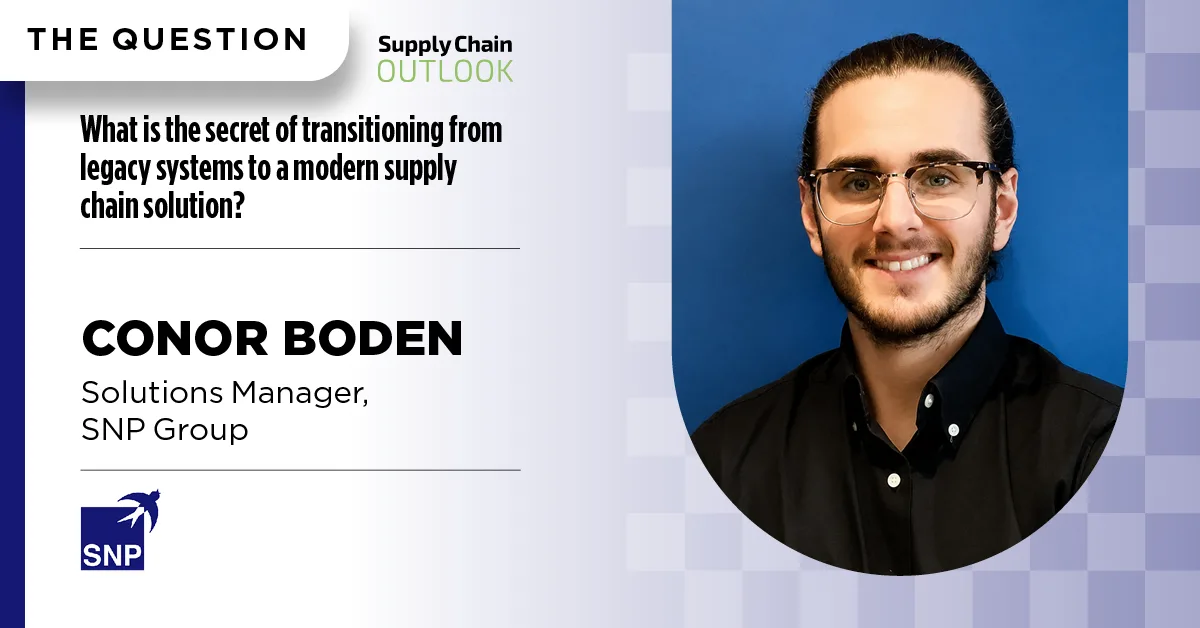
Connor Boden
Solutions Manager, SNP Group
About Connor Boden
Conor joined the SNP UKI team as a Solution Manager. A Senior SAP Consultant specialising in Tax administration and Public Sector administration in his previous role, Conor is excited to help organisations gain a better understanding of processes, tasks and decision making within SAP platforms.
About SNP Group
SNP Schneider-Neureither & Partner SE (SNP Group) is a Heidelberg, Germany-based leader in software and consulting for digital transformation, specifically for SAP S/4HANA migrations, data management, mergers, acquisitions, and company cut-offs.
The Question is a thought leadership series published on Supply Chain Outlook, created to explore the questions shaping global logistics, procurement, transportation, and supply networks.
This edition of The Question is sponsored by Syspro.
Supply Chain Outlook features leadership insights and company stories from organisations helping to move, manage, and transform the flow of goods, services, and information around the world.
Produced as part of the Outlook Publishing global network of B2B industry magazines, The Question brings focused executive insight to audiences engaged with the people, technologies, and decisions shaping the future of supply chain.